Acton Hospital
Gunnersbury Lane, Acton, W3 8EG
Medical dates:
Medical character:
1898 - 2001
Acute. Later, geriatric
In 1897 an Appeal was launched to establish a hospital in Acton to mark Queen Victoria's Diamond Jubilee. The Cornish philanthropist John Passmore Edwards promised to donate £2,500 towards the building, provided someone else gave the land on which it would be built. Lord Rothschild and Mr. Leopold de Rothschild, wealthy landowners and bankers of Gunnersbury Park, duly donated a half-acre plot, while some £1,178 13s 7d (£1,178.68) had been collected for the project by local residents. Lady Rothschild laid the foundation stone for the hospital on 8th June 1897.
The Passmore Edward Cottage Hospital was officially opened in May 1898 by Mrs Creighton (the first President of the National Union of Women Workers), accompanied by her husband, the Bishop of London.
The Hospital had 12 beds and occupied mainly the ground floor, with two wards containing 4 beds and a cot each. The female ward was named Ethel Ward and the male one Rothschild Ward. Adjacent to these were two special wards, each with a single bed. The upstairs rooms in the central block contained the staff quarters.
The Hospital was supported by voluntary subscriptions and donations of money and gifts of foodstuffs and practical items. Poor patients resident in Acton, or employed by a resident of Acton, were admitted free of charge. If there was a bed vacancy, a paying patient could be admitted for operation or as an accident case for a minimum charge of 2 guineas (£2.10) a week. However, only one paying patient at a time was allowed. As with other voluntary hospitals, maternity cases or patients with infectious diseases, incurable illness, advanced TB, epilepsy or mental disorders were ineligible for admission. Prospective patients had to produce a letter of recommendation from a subscriber and a medical certificate, except in emergency cases.
The medical staff of 7 local General Practitioners gave their services without charge. The nursing staff consisted of a Matron, a qualified nurse and a probationer.
Associated with the Hospital were a Nursing Institution, run by two Queen's Nurses who provided care for patients in their own homes, and an Invalid Kitchen which, as well as catering for in-patients, made and delivered meals to patients who were ill or convalescing at home, including any special dinners ordered by a doctor. During the first seven months of the Hospital's operational life, some 1,766 meals had been prepared by the cook, Mrs Wood, at an average cost of 11d (£0.05) each.
In 1901 the Hospital had to close for two months because of lack of funds, but things picked up and, by the turn of the century, it had a provident dispensary and a rapidly expanding Out-Patients Department. In 1902 the out-patients waiting room was improved. A Committee Room was added, as well as more staff bedrooms. By 1904 the in-patient accommodation had doubled to 24 beds. A telephone link to the local doctors was installed so that they could be reached quickly.
Lord Rothschild donated another quarter-acre of land and, in 1909, when an operating theatre and a children's ward were added, the Hospital contained 30 beds.
In 1915, during WW1, it was renamed Acton Hospital. One ward was set aside for military patients, while the Committee Room was converted into a ward, also for sick and wounded servicemen. The Invalid Kitchen was discontinued.
In 1916 an agreement was reached with Acton District Council that the Hospital would provide an antenatal clinic, a bed for patients with complicated pregnancies, and an infant dispensary.
After the war an Appeal was launched to build a new wing for the Hospital as a War Memorial to those residents of Acton who had given their lives in the service of their country. Despite great national economic hardship, some £4,699 19s 4d (£4,699.97), of the £21,000 needed, had been raised by the time the Appeal closed in October 1920.
In 1920 the Hospital had 35 beds and, rather than receiving free treatment, patients paid according to their means.
The land around the Hospital building had been sold in the early 1920s, but its owner, Mr Stevens of Heathfield Lodge, was persuaded to sell one acre (0.8 ha) to the Hospital Trustees for £1,500 (a substantial amount at that time). Most of the plot was to the rear of the Hospital, but there was a 50 ft (15 metre) frontage on Gunnersbury Lane. The Hospital then owned almost 2 acres (0.8 ha) of land.
By October 1921 some £14,905 had been raised and work began on the new wing, to the south of the original Hospital.
The War Memorial Wing was officially opened in July 1923 by Neville Chamberlain, the Minister of Health. It had two wards in the south west corner, adding an extra 17 beds, with a waiting room at the northeast corner.
The Hospital was renamed the Acton War Memorial Hospital. It had 52 beds. By this time it was considered to be one of the finest suburban general hospitals,with a Resident Medical Officer and a fully qualified nursing staff of 16 (including a Theatre Sister and a night nurse), an X-ray Department, a Massage Department, a Blood Transfusion Service and a large Out-Patients Department. It was equipped with Sun-Ray arc lamps for the treatment of children with rickets. It also provided private beds, at a charge of 4 guineas (£4.20) a week, for patients who could not afford the higher fees of a nursing home.
In 1924 Acton District Council provided an ambulance for the Hospital. The Council also agreed to pay for schoolchildren to have their tonsils and adenoids removed, at the rate of £1 11s 6d (£1.57) per child, including an overnight stay.
Following further extension in 1928 the Hospital contained 62 beds. In 1929 a Nurses' Home was built, at a cost of £17,500. The building contained 39 single rooms, as well as sitting and dining rooms and offices.
By the 1930s Acton had become the second largest industrial area south of Birmingham, with increasing population. The Hospital needed to expand yet again, and in 1933 work began on another extension, which opened in 1934. The Hospital then had 64 beds. A new X-ray room with a new apparatus was also added.
In 1936 the Out-Patients Department was enlarged and a new female ward with 18 beds was opened by Mr Harold Wesley, a stationery manufacturer of North Action, who had donated £2,500 to make the extension possible. The Hospital then had 72 beds.
In 1939 No. 30 Hillcrest Road was purchased to provide access to the rear of the site and the Nurses' Home. A hard tennis court was built in its garden.
At the outbreak of WW2 in September 1939 the Ministry of Health ordered the Hospital to be cleared so that its beds could be used for anticipated air-raid casualties. Only 19 patients remained. The Hospital became part of the Emergency Medical Scheme (EMS). In addition to its own 72 beds, it was supplemented by 42 EMS beds, to give a bed complement of 114. Acton District Council took over part of the Out-Patients Department to set up a First Aid Post (paid for by the Ministry of Health). A Decontamination Unit was built in the grounds of the Hospital in the expectation of gas cases (it was turned into the Casualty Department in 1950).
The Hospital was upgraded after WW2 and joined the NHS in 1948
as a general hospital under the control of the Central
Middlesex Group Hospital Management Committee, part of the North West
Metropolitan Regional Hospital Board. It had 84 beds and a large
well-equipped X-ray Department and a large Physiotherapy Department. The average stay of an in-patient was 16 days (chronically sick patients stayed on average 181 days).
In March 1953 the Hospital was linked with Leamington Park Hospital for administration and nursing purposes. In 1966 it had 85 beds.
In 1974, following a major reorganisation of the NHS, the Hospital was transferred to the control of the North Hammersmith (Teaching) District Health Authority, part of the North West Thames Regional Health Authority. It worked closely with the Hammersmith Hospital.
In 1975 the Regional Health Authority recommended that it should cease to be a district general hospital, but become instead a community hospital.
In 1979, when the Hospital had 72 beds, it became a geriatric hospital for patients requiring long-term care and rehabilitation. The operating theatre area was converted into a Physiotherapy and Occupational Therapy Department at a cost of £30,000.
In 1980 the former Casualty Department was redeveloped as the Gunnersbury Unit, for the assessment of the elderly mentally ill.
Following another NHS reorganisation in 1982, control of the Hospital passed to the Hammersmith Special Health Authority (which, in 1985, became the Hammersmith and Queen Charlotte's Special Health Authority).
In 1994 the Hospital became part of the Hammersmith Hospitals NHS Trust, together with Hammersmith Hospital, Charing Cross Hospital and Queen Charlotte's and Chelsea Hospital.
The Hospital finally closed in 2001.
Present status (December 2007) The Passmore Edwards Memorial Garden was created in 2011. |
|---|
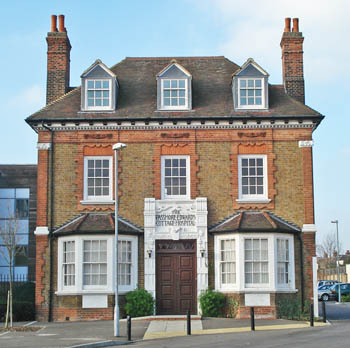
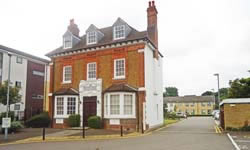
While most of the site is a modern health care centre, the original building for the Passmore Edwards Cottage Hospital survives, tucked away just off the main road, looking in pristine condition. Only the central part remains; the wings have been demolished.
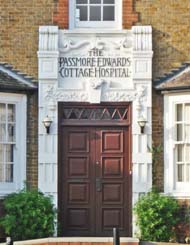
The doorway still bears the name of the Cottage Hospital, which is a locally listed building.
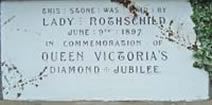
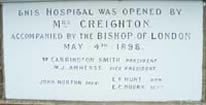
The foundation stone laid in June 1897 by Lady Rothschild (left) and the masonry plaque commemorating the opening of the Hospital in May 1898 by Mrs Creighton (right) are still located beneath the bay windows of the building.
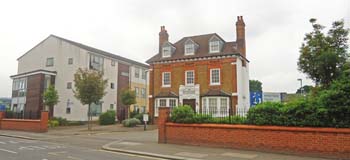
The pretty Cottage Hospital building is dwarfed by the shed-like Acton Care Centre.
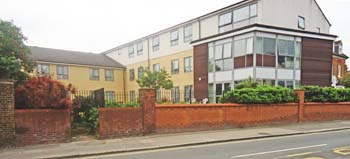
The Acton Care Centre with the Passmore Edwards Memorial Garden behind the original brick wall. The Cottage Hospital building can just be seen at the extreme right of the image.
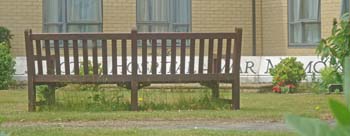
The stonework for the War Memorial Wing has been preserved in the Passmore Edwards Memorial Garden and can just be discerned behind the garden bench.
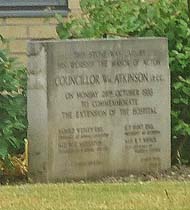
A commemorative stone for the 1933 extension also decorates the garden.
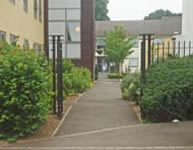
The Care Home extends to the rear, far beyond the original Hospital building.
References
(Author unstated) 1897 Reflections from a Board Room mirror. Nursing Record and Hospital World, 3rd April, 279.
(Author unstated) 1897 Reflections from a Board Room mirror. Nursing Record and Hospital World, 19th June, 507.
(Author unstated) 1898 Coming events. Nursing Record and Hospital World, 30th April, 366.
(Author unstated) 1898 Reflections from a Board Room mirror. Nursing Record and Hospital World, 14th May, 403.
(Author unstated) 1997 Acton Hospital 1897-1997. London, Acton History Group.
www.iwm.org.uk (1)
www.iwm.org.uk (2)
www.iwm.org.uk (3)