City of London
Maternity Hospital
65 Hanley Road, Tollington Park, N4
Medical dates:
Medical character:
1750 - 1983
Maternity
Several lying-in hospitals were built in London during the mid 18th century, intended for "the wives of poor industrious tradesmen or distressed housekeepers".
On 30th March 1750 a meeting was held by ten benevolent gentlemen at the Black Swan Tavern in Bartholomew Lane to found a lying-in hospital for married women and for 'sick and lame out-patients' in the City of London. Medical staff and administrators were appointed and, in May, the City of London Lying-In Hospital for Married Women and Sick and Lame Out-Patients opened in an apartment, converted for the purpose, in London House, Aldersgate Street. It was the third oldest institution of its kind.
In less than a year, on 11th January 1751, it moved to Thanet House (later renamed Shaftesbury House), also in Aldersgate Street. In September 1751 the Governors decided that no more out-patients should be admitted and the Hospital became known as the City of London Lying-In Hospital for Married Women.
In 1753 the nursing staff consisted of a Matron and four nurses. A domestic servant was also employed. All confinements took place in the wards (separate labour wards were only provided after 1860).
In 1769 the Hospital Governors decided to build a purpose-built
hospital and a site was leased for an annual fee of £50 from St
Bartholomew's Hospital on the corner of City Road and Old Street, near St Luke's Hospital for Lunatics.
The foundation stone was laid on 10th October 1770. The new Hospital opened on 31st March 1773. The 2-storey building was made principally of wood and had cost £3,000. It was planned to have 42 beds in three wards.
During the 18th century all babies born in the Hospital were expected to be publicly baptised in its chapel; collections during the ceremony provided an income for the Hospital. Special sermons, benefits, plays and sacred music concerts also raised funds.
In 1872 an 'outdoor' maternity department was established, whereby District Midwives employed by the Hospital attended to expectant women and delivered them in their own homes. At first only those living within a mile of the Hospital were included, but the service became very popular and was rapidly extended.
On 24th November 1877 a severe outbreak of puerperal fever caused the Hospital to be closed for 18 months. It reopened in April 1879. However, despite sanitary improvements, mortality remained exceptionally high and, in June 1880, antiseptic rules were introduced.
During 1880, the Hospital admitted over 1,000 in-patients, but about three times that number were attended to as out-patients by the District Midwives. By 1883, when the Hospital had to be temporarily closed again, the outdoor maternity department included not only the City of London, but Shoreditch, Islington, St Luke's, Bethnal Green, Clerkenwell, Spitalfields, Hackney, Whitechapel and Holborn. (By 1898 parts of Stoke Newington and South Hornsey were also included.)
In 1888 the Governors decided that, in exceptional circumstances, single women could be admitted for a first confinement, but only after careful investigation by a committee of men.
In 1893 the nursing staff consisted of a Matron, a head nurse, a night superintendent and two midwives, as well as 8 pupil midwives and 19 pupil nurses. Other staff included 6 servants, a needlewoman and a messenger. The weekly cost of an in-patient was 6s 10d (34p), compared to 6s 2d (31p) in 1889.
At the beginning of the 20th century the building was damaged by
the
construction works for the Great Northern and City Railway underneath
Old Street. The excavations caused serious subsidence, with a
wall abutting on the street found to be 8 inches out of the
perpendicular. After considerable discussion the railway company paid
the Hospital Governors £3,000 in settlement of their claims.
Because parts of its building were condemned by the LCC, in 1901 the Hospital moved to temporary accommodation at 228 Old Street. In 1904 the old Hospital building was demolished and a new one built on the same site. It was officially reopened on 1st July 1907 by Princess Christian of Schleswig-Holstein. It had 71 beds and had cost nearly £35,000 to build.
During 1910 some 842 in-patients were admitted, while 2,742 out-patients were attended to in their own homes.
Following the National Insurance Act, 1912, maternity benefit was introduced. The number of out-patients decreased, while admission rules were relaxed for 'deserving' single women.
In 1916 a Child Welfare Department was established.
In 1918 the Governors felt that the term 'lying-in' did not cover the post-natal and infant welfare work also being undertaken, and the Hospital's name was changed to the City of London Maternity Hospital. It had 82 beds.
In 1920 a paediatrician was appointed to the staff.
At the outbreak of WW2 in 1939 the Hospital made preparations for
evacuation. Brocket Hall, near Welwyn Garden City, Herts, was
equipped with 49 beds and staffed and, on 2nd September 1940, half the in-patients were
transferred there. Brocket Hall was administered by Hertfordshire County Council.
On 9th September 1940, a week after the evacuation, the northern wing of the Hospital was destroyed by a bomb, fortunately with no loss of life. The remaining in-patients were transferred to Friern Hospital, some ten miles away.
No more in-patients could be admitted after that and they were sent instead to Brocket Hall; or to Friern Hospital until March 1941, when the maternity beds there were needed for war casualties.
The rear part of the building had to be demolished, although the front part continued to be used for the Out-Patients Department and administration. More bombs on 6th April and 10th May 1941 further damaged the building.
The out-patient maternity service continued, with expectant mothers delivered in their own homes, whilst those willing to leave London were sent to Brocket Hall.
In January 1942 12 emergency maternity beds were made available in the London Fever Hospital in Liverpool Road. The number was later increased to 40.
In 1946, after the end of the war, the Hospital took over financial responsibilities for Brocket Hall from Hertfordshire County Council.
In 1948 the Hospital joined the NHS under the control of the
Northern Group Hospital Management Committee, part of the North West
Metropolitan Regional Hospital Board.
It agreed to amalgamate with the Gynaecological and Obstetric
Department at the Royal Northern Hospital.
It was decided not to rebuild the Hospital on the noisy City
Road and, in November 1949, it reopened with 52 beds in Hanley
Road, in premises bought from the Institute of the
Blind. Clinics continued to be
held in the City Road building until 1955 when a new Out-Patients
Department was built
adjacent to the Hanley Road premises.
In 1974, following a major reorganisation of the NHS, the Hospital became part of
Islington District Health Authority, part of the North East Thames
Regional Health Authority.
By 1980 it had 86 beds but, in 1983, in yet another NHS reorganisation,
it was amalgamated with the Whittington Hospital. The Hanley Road
building closed and services were moved to the Whittington Hospital to
form the City of London Maternity Unit with 47 beds.
|
Present status (February 2009) |
|---|
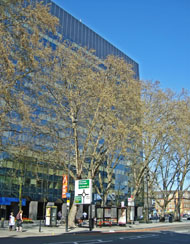
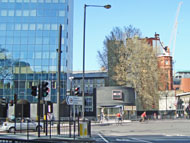
The original Hospital site, adjacent to St Luke's Hospital for Lunatics, on the corner of City Road and Old Street.
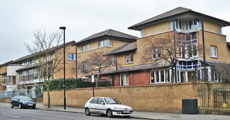
Looking from the west on Hanley Road.
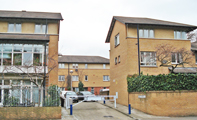
Looking into Hanley Gardens.
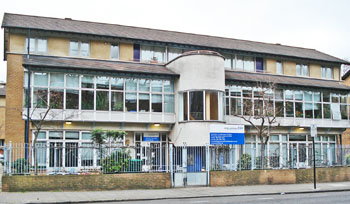
The NHS Education and Employment Centre in the middle of the estate.
References (Accessed 10th February 2017)
(Author unstated) 1823 The City of London Lying-In Hospital, City-Road, for the Reception and Delivery of Poor Pregnant Married Women. London, self-published by the Hospital.
(Author unstated) 1903 Reflections from a Board Room Mirror. British Journal of Nursing, 10th October, 296.
(Author unstated) 1907 Coming events. British Journal of Nursing, 29th June, 500.
(Author unstated) 1950 City of London Maternity hospital. Bicentenary Celebrations. British Medical Journal 1 (4655), 725-727.
Black N 2006 Walking London's Medical History. London, Royal Society of Medicine Press.
Cannings RB 1922 The City of London Maternity Hospital. A Short History. London, privately published.
Risler A 2007 An Illustrated History of the Royal Northern Hospital. London, privately published.
Seligman SA 1980 The Royal Maternity Charity: the first hundred years. Medical History 24, 403-418.
http://collage.cityoflondon.gov.uk
http://discovery.nationalarchives.gov.uk
http://hansard.millbanksystems.com
https://sickcityproject.wordpress.com
www.aim25.ac.uk (1)
www.aim25.ac.uk (2)