All Saints' Hospital
Austral Street, Southwark, SE11 4SL
Medical dates:
Medical character:
1911 - 1986
Specialist. Later, psychiatric.
The All Saints' Hospital was founded in 1911 by the
distinguished Irish surgeon, Edward Canny Ryall, to improve operative
techniques for the treatment of kidney and bladder disease. Its
name had been suggested by Mr Canny Ryall's wife - they had been
married in the All Saints' Church in Margaret Street.
Mr Canny Ryall for many years bore the main burden of the Hospital
himself, financially and otherwise. The Hospital, at 49-51
Vauxhall Bridge Road, dealt only with out-patients. However, when
the chauffeur of the then Prime Minister Mr Balfour fell ill, the Prime
Minister insisted that he be treated at the All Saints' Hospital.
A bed and bedding was urgently procured and installed in an
unused upstairs room. The patient survived his operation and the
Hospital began to admit in-patients. By 1912 it had 10 beds and 1
cot.
During WW1 it became the All Saints' Hospital for Wounded Soldiers, a
section of Queen Alexandra's Military Hospital
at Millbank, and had 22 beds for officers.
After the War it was renamed the All-Saints' Hospital for
Genito-Urinary Disease and in 1920 a large house at 91 Finchley Road
was purchased for in-patients. The Vauxhall Bridge Road building
reverted once more to dealing with out-patients only.
In 1932 the Hospital moved to Austral Street, near Lambeth Road.
It had become the largest urological hospital in the UK, with 52
beds.
During WW2 the Hospital was closed as, with other small hospitals, its
staff had been depleted by the war effort.
It reopened in 1946 with 32 beds. With the implementation of the
NHS approaching, association with a larger hospital was felt desirable.
All Saints' became one of the units of the Westminster Hospital and (until 1952) was
renamed the Westminster Hospital Urological Centre.
A new Nurses' Home - three one-storey prefabricated huts - was opened
in 1948 at the rear of the Hospital building. One hut was for
Sisters, one for nurses and one for recreational purposes. A new
state-of-the-art operating theatre was installed in the same year.
In 1951 the number of urological beds was reduced and the
gynaecological beds from the Westminster Hospital were transferred to
the 1st floor wards.
In 1960 the urological beds on the ground floor moved to the Gordon Hospital,
which was also a member of the Westminster Hospital group. The
ground floor, containing the Canny Ryall and Frederick Lane Wards, was
taken over by the Westminster Hospital psychiatric
department the following year.
The gynaecological beds returned to the Westminster Hospital in July
1971
and the All Saints' Hospital became a minimum care unit with 24 beds.
It was staffed by a Sister, a Staff Nurse, 2 State Enrolled
Nurses and 8 nursing auxiliaries.
Following a major reorganisation of the NHS in 1974 the Hospital became
a psychiatric and minimal care unit with 45 beds under the control of
the Kensington, Chelsea and Westminster Area Health Authority (South
District), part of the North West Thames Regional Health Authority.
By 1982, after another reorganisation of the NHS, it was a psychiatric unit with 31 beds for the Victoria District Health Authority. In 1985 it came under the control of the Riverside Health Authority.
The Hospital finally closed in 1986.
| Present status (January 2008) In 1986 the Imperial War Museum acquired the site; the building is now used as an annexe to house its audiovisual archives. |
|---|
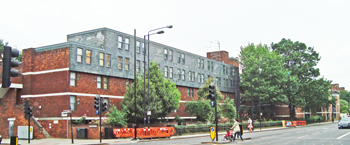
The original site of the Hospital on Vauxhall Bridge Road has been redeveloped (above and below).
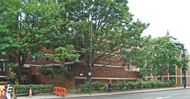
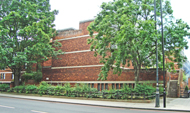
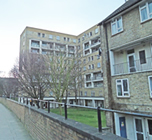
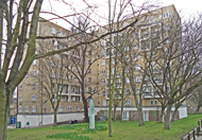
The in-patient building at No. 91 Finchley Road was destroyed by bombs during WW2. Its site is now occupied by the Hilgrove Estate.
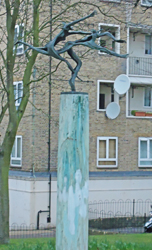
The sculpture between Redfern House and Langhorne Court on the Hilgrove Estate is roughly on the site of the former Hospital. The sculpture, commissioned by the LCC at the building of the estate is The Pursuit of Ideas by Leon Underwood.
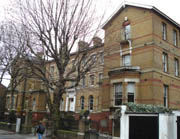
The Hospital building in Austral Street.
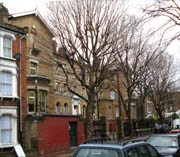
The building as seen from Brook Drive.
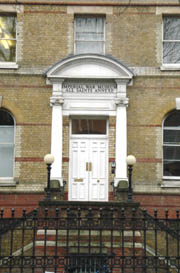
The main entrance in Austral Street.
References
(Author unstated) 1917 List of the various hospitals treating military cases in the United Kingdom. London, H.M.S.O.
(Author unstated) 1948 Westminster Hospital Urological Centre. British Medical Journal 1 (4564), 1247